
Don’t Ever Stop! worked in an elementary school in Southwest Colorado in an attempt to improve learning for K-5 students. Our efforts focused on helping the principal and staff become more standards-based and to share the responsibility of learning with the students. In our previous sessions we shared bar charts, proficiency ladders and had staff prioritize the Common Core State Standards in ELA into essential learnings. The staff worked very responsibly at this task and pared down the ELA standards from forty-three to approximately fifteen to twenty essentials for each grade level. The teaching staff was surprised that someone had the audacity to suggest that this prioritization was necessary for them to be effective and to maintain their sanity.
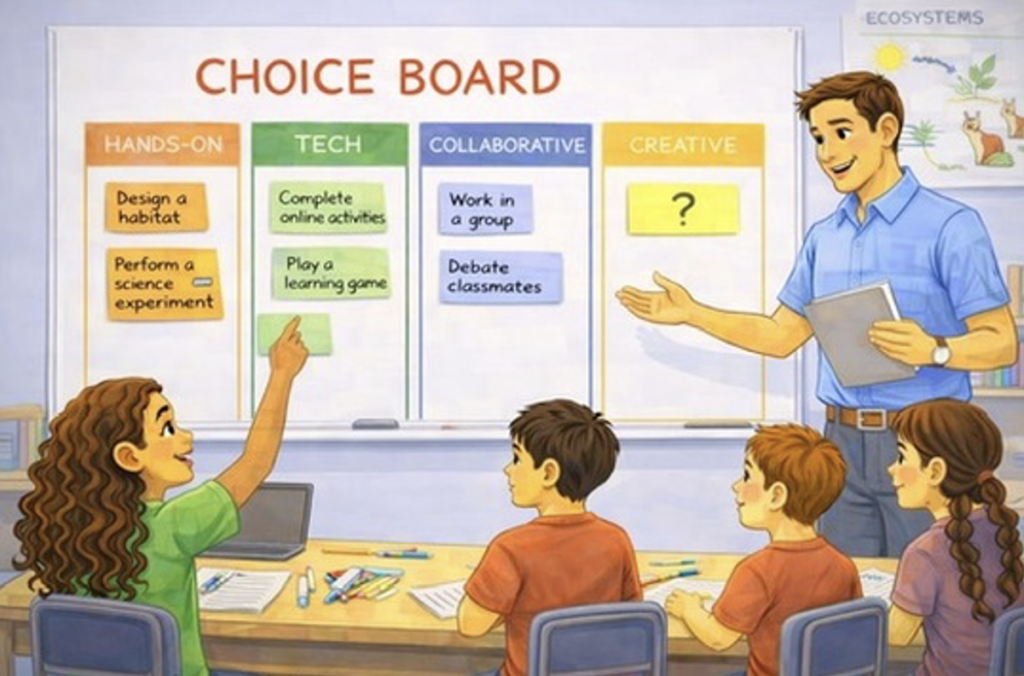
Next, the concept of “choice boards” was shared with the staff in a professional development setting. Choice boards are tools used to give students choice in ways to accomplish proficiency on a standard while assuring rigor and alignment to the standards. This tool allows students to own their learning and to move at their individual pace. Because choice boards scaffold from the previous grade level standards to the current grade level standards, teachers (after pre-assessment) can assign students to the appropriate level to begin their work on the choice board. This means students will receive instruction at their instructional level and progress to the grade level standard as they show evidence of proficiency to their teacher.
The staff of this elementary school chose to write a common choice board for W.2, Informative/Explanatory text. This meant the entire school would have a set of choice boards on a common standard. The advantage of this decision is that the grade levels can support each other with lessons and materials to help students attain grade level proficiency. For instance, if a 5th grade student can only perform at 4th grade level on standard W.2 the 5th grade teacher can get help from 4th grade teachers on the next steps that need to taken to work towards proficiency on the 4th grade W.2 standard. When that proficiency is attained the student will then progress to 5th grade W.2.
The process used to create this set of choice boards was that each grade level shared their four choices (one choice always being a student-created choice) with DES. DES then put together the choice boards for the entire school. This was done to model the process for the staff. In the future, staff will be able to create their own choice boards as they deem necessary. The choice boards have now been given to staff and a Plan-Do-Check-Adjust process will be used to refine this tool.
So, in just two months this school has learned about: bar charts, proficiency ladders, identified essential learnings, and created a school-wide set of choice boards. This prompted one veteran teacher to comment “I feel like a new teacher”. She is expressing a common sentiment. Change is hard. She also related that she has never been so focused on standards and her students now know where they stand at being proficient. The principal and staff have expressed that this work is the “real work” that must be done to improve academic performance at their school.
Next steps: DES was at school for their next visit to explain the choice boards that were created and began a coaching cycle with each teacher in the school to see how the tools are working in classrooms to aid learning.