Category: Personalized

  • Increasing Student Goal-setting and Engagement

    Our work continued with an elementary school in Southwest Colorado attempting to improve learning for K-5 students. During our last visit we spent time in 5 teacher’s classrooms and provided specific feedback on their progress in using the tools that have been shared to date. These five teachers reported to the rest of the staff:

    1. Frustration due to their lack of experience with the tools. 
    2. Excitement about students beginning to own their learning. 
    3. Excitement over several students choosing the score 4 option on ladders.
    4. Astonishment about how focused they were now on the standards. 
    5. Recognition of the need to carve out time to provide feedback for students.
    6. Curiosity about the process of creating SOPs to free up time for conferencing.
    7. Accomplishment in sharing the work being done with data folders kept by the students. 
    8. Understanding that more than one standard can be accomplished at a time.

    None of these comments surprised us but several were exciting, considering the staff has only had these tools for six weeks. We continued to address the needs or frustrations that were expressed and provided professional development and used a coaching model to mitigate concerns. DES reminded these teachers to be careful not to fall in to the trap set by their own “perfectionism.” They are learning new teaching strategies and helping students own learning, which is a new skill for the entire staff and student body. It was encouraging to hear that some students were setting high goals for themselves and wanted to do more than be “proficient “ on a standard. 

    DES shared the completed choice boards on CCSS W.2. Using the PDCA process the staff discovered that there needed to be a better understanding and application of research based vocabulary strategies in their classrooms.  The principal agreed to distribute to staff materials about the Frayer Model, Marzano’s Six Step Vocabulary Strategies, and Harvey Silver’s Vocabulary Strategies. This conversation revealed an interesting truth about teaching in our schools. Many teachers use several strategies for instruction and, we might say, use them well, without remembering where the strategies originated or why these strategies are effective. This is a symptom of teachers not having the time to reflect on practice. They need time be able to Plan, Do Check and Adjust. Not just be caught up in a cycle of Plan, Do, Plan Do.

    The Crosswalk and Lessons Learned:

    The state of Colorado has adopted a set of standards called the Colorado Academic Standards (CAS). DES has written the proficiency ladders using the Common Core State Standards (CCSS). So, to make sense out of DES ladders it was necessary to cross walk the Common Core to the academic standards of Colorado. The teachers of our Colorado school have identified 101 English Language Arts standards as essential standards. That is to say, there are 101 standards that must be mastered to proficiency across Kindergarten to grade 5 in English Language Arts. To put this in perspective there are approximately 250 ELA standards at the elementary level. The non-essentials are to be taught but students are not held to proficiency on those standards. In any case, it was important for these teachers to know the CAS their students are mastering.  In cross walking the 101 CCSS to the CAS the most intriguing observations were:

    1. The language used in the two sets of standards is identical.
    2. The numbering system of the two sets of standards is not identical.

    Because DES spent a large amount of time in cross walking these two sets of standards and discovering the truth of the statements above it caused us to wonder; Why did the state feel it had to go through the brain damage and expense of renumbering the CCSS? It is essentially the same set of standards renamed and renumbered. Although the answer given here is conjectural, DES suspected the answer is a political one. The CCSS have come under fire from some of the public who fears a national influence on the education of our children. The reality is that the move to a common set of standards originated with governors of states who realized that something had to be done to improve our educational standing in the world setting. Remember education, according to the Constitution, is a matter for the states. Colorado’s educational system prides its self as a local control state. The  Colorado Department of Education created the CAS to be model for 178 very independent thinking districts. The debate about the CCSS will become a major political issue over the next election cycle. DES suspected that some states, Colorado being one, wanted to assert that they have created their own set of standards and will want to avoid the criticism which was voiced against the Common Core. It was interesting to see how this all plays out in the near future. 

    This elementary school continued to work hard to bring more students to proficiency on the essential standards. The principal is well supported by the district, and the staff is gaining an understanding of what it takes to be standards-based. Along with the standards focus of this school, it is important to partner with the students to motivate them to want to improve academically. 

    Next steps: The staff and principal of this school began to agree that the next step in this process is to include a student goal setting and planning aspect to the classroom. So, in our next visit there was a focus on student planning tools. The staff will bring the tools they currently use for student planning and DES tools will be exhibited. This will be done during professional development. The coaching model will also be employed to provide staff with timely and specific feedback about successful utilization of tools to move to personalized mastery. It was important to check in with staff to give feedback on Standard Operating Procedures (SOP) and the use of proficiency ladder data in the school Multi-tiered Support System (MTSS)process.
  • Mastery Learning through Choice

    Don’t Ever Stop! worked in an elementary school in Southwest Colorado in an attempt to improve learning for K-5 students. Our efforts focused on helping the principal and staff become more standards-based and to share the responsibility of learning with the students. In our previous sessions we shared bar charts, proficiency ladders and had staff prioritize the Common Core State Standards in ELA into essential learnings. The staff worked very responsibly at this task and pared down the ELA standards from forty-three to approximately fifteen to twenty essentials for each grade level. The teaching staff was surprised that someone had the audacity to suggest that this prioritization was necessary for them to be effective and to maintain their sanity.

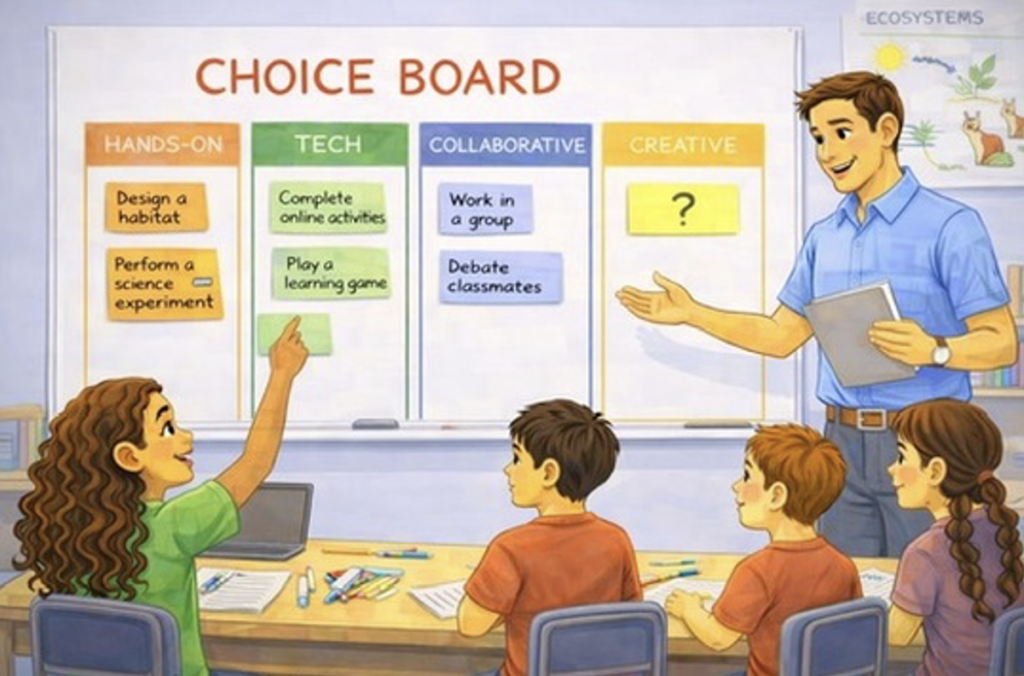
    Next, the concept of “choice boards” was shared with the staff in a professional development setting. Choice boards are tools used to give students choice in ways to accomplish proficiency on a standard while assuring rigor and alignment to the standards. This tool allows students to own their learning and to move at their individual pace. Because choice boards scaffold from the previous grade level standards to the current grade level standards, teachers (after pre-assessment) can assign students to the appropriate level to begin their work on the choice board. This means students will receive instruction at their instructional level and progress to the grade level standard as they show evidence of proficiency to their teacher.

    The staff of this elementary school chose to write a common choice board for W.2, Informative/Explanatory text. This meant the entire school would have a set of choice boards on a common standard. The advantage of this decision is that the grade levels can support each other with lessons and materials to help students attain grade level proficiency. For instance, if a 5th grade student can only perform at 4th grade level on standard W.2 the 5th grade teacher can get help from 4th grade teachers on the next steps that need to taken to work towards proficiency on the 4th grade W.2 standard. When that proficiency is attained the student will then progress to 5th grade W.2.

    The process used to create this set of choice boards was that each grade level shared their four choices (one choice always being a student-created choice) with DES. DES then put together the choice boards for the entire school. This was done to model the process for the staff. In the future, staff will be able to create their own choice boards as they deem necessary. The choice boards have now been given to staff and a Plan-Do-Check-Adjust process will be used to refine this tool.

    So, in just two months this school has learned about: bar charts, proficiency ladders, identified essential learnings, and created a school-wide set of choice boards. This prompted one veteran teacher to comment “I feel like a new teacher”. She is expressing a common sentiment. Change is hard. She also related that she has never been so focused on standards and her students now know where they stand at being proficient. The principal and staff have expressed that this work is the “real work” that must be done to improve academic performance at their school. 

    Next steps: DES was at school for their next visit to explain the choice boards that were created and began a coaching cycle with each teacher in the school to see how the tools are working in classrooms to aid learning. 

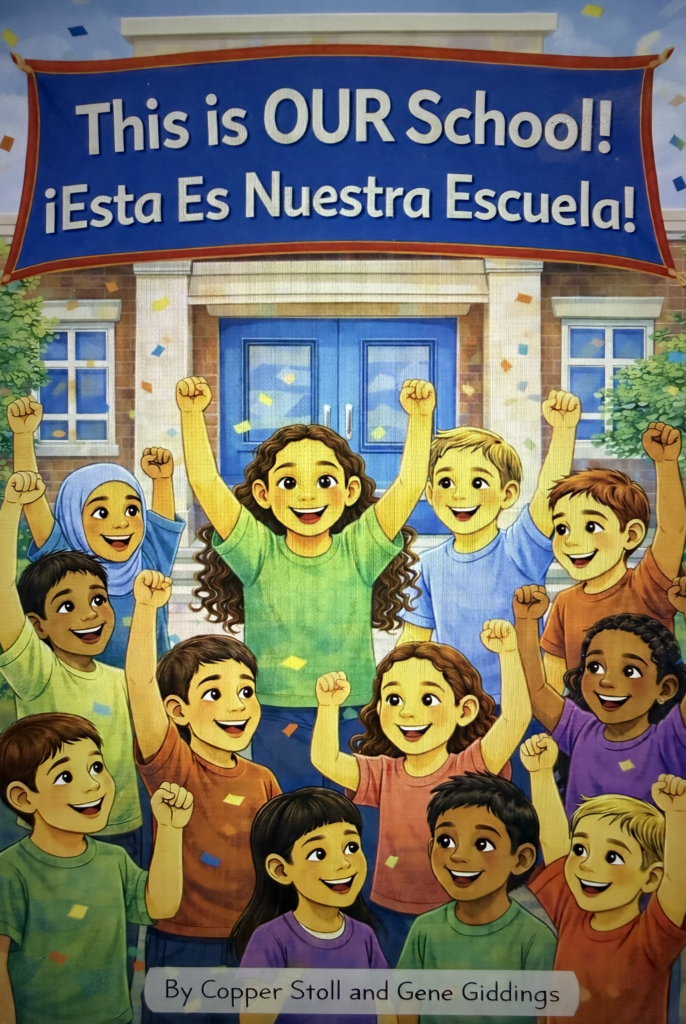
  • DES’ Journey to Create a Children’s Book

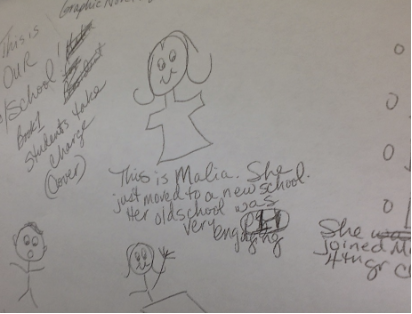
    When Copper was in District 50 and was the Chief Academic Officer, she wanted to have a vehicle to explain to children and parents the personalized mastery way of learning that was evolving in the district.  She drafted the narrative of a Children’s book that was illustrated by 4th graders in Diane Logsdon’s class.  We had 10,000 books printed and every student was given one to take home to read and discuss with their parents.  

    After spending the last 18 years trying to convince and transform school systems to change and empower learners to master the standards, Gene and Copper have felt there needed to be another lever for change.  They brought back the idea of using a Children’s Book to help people visualize the possibilities.  

    In 2019, they brainstormed ideas for a series of children’s book to motivate kids to be involved in their own learning and show teachers what it might look like.

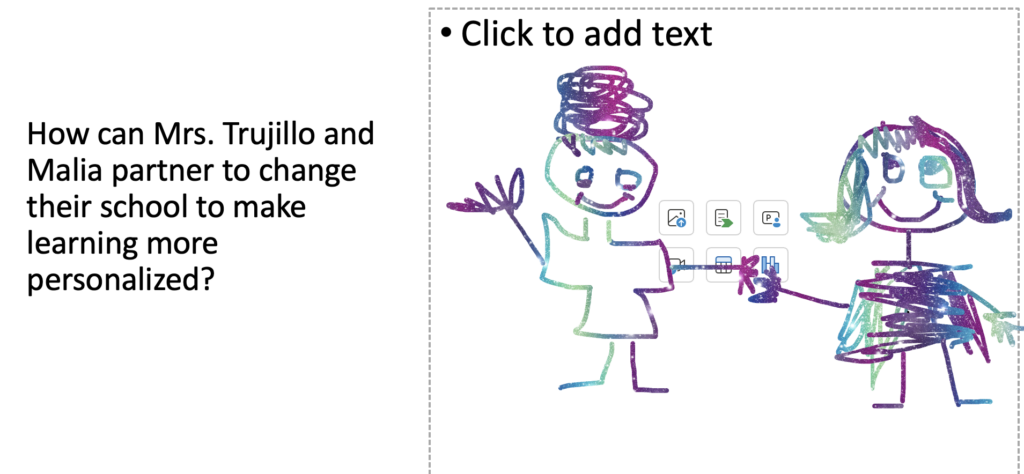
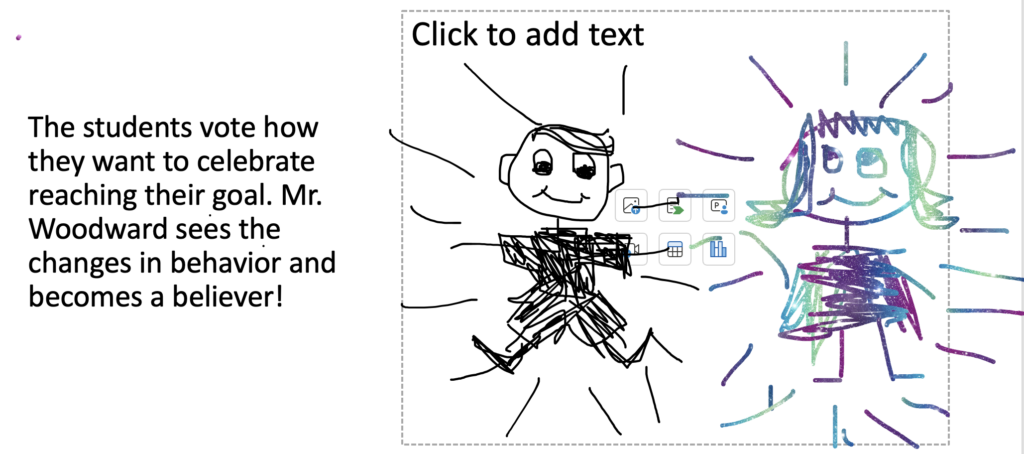
     They started with Stick figures on Jan 28, 2020. DES meets in person once a month and daily on the phone to further their work.  They created a draft of Book 1 in a Powerpoint with stick figures dated February 21, 2020. 

    Pages from the Powerpoint:

    Unfortunately, the pandemic shut down the world and so the idea was shelved.  The pandemic and opportunity to work in Wyoming Spring of 2022 postponed any further work on the Children’s book.  In the meantime, we were trying to find someone to illustrate the book but was too expensive. 

    With the creation of AI and our subscription in Chat GPT, we brought the book back out in the Fall of 2024 and began to create illustrations to match the narrative. As that work was progressing, we offered the book idea to our former publisher that had been bought by Bloomsbury. They weren’t interested in a picture book.

    When the book was drafted we made a flip book with narrative and illustrations and shared it with TAMIS (an elementary school) in Mexico that Copper was consulting  with.  We decided that the book needed to be bilingual in Spanish so we used Google Translate to convert the English version and had a teacher at TAMIS read and refine the grammar. We also added a definition to right on the same page instead of creating a separate glossary.  We hoped this would enhance comprehension of the tools and education-ese. 

    We decided to self-publish and completed the draft into an Amazon Kindle paperback book but were unsatisfied with the coloring of the muted illustrations and redid the illustrations in more primary colors. We resent the more colorful draft to Amazon, examined a proof and had it finalized for print.

    We have been sharing the book with friends and family and our most interesting feedback came from our grandsons, who both said separately, “Teachers don’t want our feedback”, which underscores the need for a philosophical shift to partner with the learners.

  • Why students should learn in exemplary classrooms!

    Why students should learn in exemplary classrooms!

    Learning should happen with students, not to students

    Gene and Copper, along with other proponents of personalized mastery, have been faced with the challenge of attempting to reform our current educational model away from a traditional teacher-centered system to a learner-centered system in which students partner with teachers and have direct ownership of their own learning goals. Many observers would argue that like-minded proponents of personalized mastery are engaged in a losing battle. They would say the current system is very resistant to change and that the adults who would have to become the “change agents” are not interested in the hard work that would be necessary to share the important task of sharing schooling with our children. Many teachers don’t trust their students to be partners in their own learning after all, “What do the kids know?”.

    In this kind of climate, where the system is very resistant to change, reformers must attempt to find a variety of leverage points to get our educational system to become a system that embraces continuous improvement. These leverage points include:

    1. learning about the research that supports the personalized mastery (PM) concept,
    2. engaging in staff development in districts that have an interest in a PM model
    3. convincing teachers, one at a time, that this way of learning must be adopted to prepare our children for the 21st century.
    4. moving our schools to encourage teachers to change by harnessing teacher evaluation systems that will reward the effort necessary to change teacher- centered practice to more learner-centered practice.

    We are happy to say that such an effort is indeed under way all across the nation. The co-founders of Don’t Ever Stop have been following the efforts of a large metropolitan district that is committed to improving learning for their students.  The district’s Charlotte Danielson’s teacher evaluation tool has four domains: Planning, Classroom Environment, Instruction, and Professional Responsibilities. The associated rubric also has four performance levels that range from “Requires Action”, “Progressing”, Accomplished” and “Exemplary” practices.  The focus of our interest in this work was the effort to calibrate district and school administrators in observing with consistency the  classroom practices in Domain 2, Classroom Environment and Domain 3, Instruction. One of the major points of emphasis of this work was to focus the observers’ eye on student learning instead of teacher behavior.

    We have watched teachers and administrators adjust their focus from a checklist of teacher behavioral traits to gathering data from the learners regarding what they are learning.  Most teachers are meeting the criteria for an “Accomplished” score in the Classroom Environment.  What this means is, teachers are still setting an effective classroom culture, but without partnering with their students.

    Classroom Instructional practice is mostly scoring in the “Progressing” category. This means students are experiencing limited learning in teacher-directed classrooms.  It’s not until “Exemplary” practice is demonstrated that students will be learning in a student-centered classroom. If students learn in student-centered classrooms that exemplify the criteria of “Exemplary” practice as much as possible then schooling happens with the learners instead of to them.

    Although “Exemplary” practice is defined in the rubric and outlines learner-centered practices, what we have observed from this work is:

    In Domain 2-Classroom Environment

    • While the classroom environment is “Accomplished”, for the majority of classrooms, students are not actively involved in setting, monitoring and celebrating the classroom culture. 

    In Domain 3- Instruction

    • Students are rarely aware of the learning objectives of lessons.  When students were asked, “what you are doing?” students are able to describe the topic of the day or the activity.  When students are asked, “what you are learning?” they struggle to explain the actual learning. 
    • The use of formative and pre-assessment practice to inform instruction is moving slowly. Students are rarely aware of assessment criteria and data, and do not engage in self- or peer-evaluation. Because formative practice is not in place, students are only occasionally given specific feedback and the time to perfect their learning. Lessons usually consist of whole group instruction with the same activity or lesson, not differentiated by any data. Students are summatively assessed and Multi-Tiered System of Supports (MTSS) time is allocated to remediate skills. However, most teachers do not know which students need this lesson and which students already know this material. Students are not grouped based on the learning data gathered during lessons.
    • Some students are engaged in relevant, interesting real-world learning, most are not.  Students therefore are ritualistically engaged in lessons.  Luckily for this district their students are compliant to the plans of the adults. Students were often busy however they were not intellectually engaged and therefore real learning is rarely observed. 
    • Currently, questioning and discussion is another component that only occasionally engages students.  Teachers are using upper level questions however the discussion that follows usually consists of a conversation back and forth with the teacher.  Rarely do students discuss topics with one another, with the teacher stepping aside.  Growth has been seen with teachers encouraging accountable talk from students.

    In order for this district to continue to progress in creating a system that partners with learners and teachers in increasing student learning, we offered the following recommendations for consideration:

    • Students need to be allowed voice and choice in their culture and learning. If teachers assisted students in the creation of a vision and a code of collaboration, the students will feel more like learning is a shared experience.  Then students and teachers should identify the protocols needed for the classroom to run efficiently and effectively.  Students can choose the manner and content of celebration once classroom culture goals are achieved.
    • There is definitely the will and the way to engage learners in student-centered practice.  The district rubric that defined “Exemplary” practice should become the norm.  Teachers need to be encouraged to live in the category of “Exemplary” instead of only visiting it on occasion. If students and teachers live in “Exemplary”, then students and teachers are partners.
    • To the credit of the administrators, they are beginning to see the difference between compliance and intellectual engagement.
    • Students need to continue to be taught how to use “accountable talk” and students need to ensure the involvement of all students in the discussion. 
    • Formative assessment practice should be more fully embraced to inform instruction, provide quality feedback for students to improve and deepen their learning, inform content for interventionists, and students to track their own learning.  Adherence to a rigid pacing guide encouraged whole group instruction whether it’s needed or not and does not allow teachers to remediate or accelerate instruction based on learner’s needs.  If students know they are ready for assessments based on their learning of the material, “hope” is fostered for student learning and assessment.

    DES’s hope is that the effort of this district, and other districts around the nation, use the teacher evaluation tool as a feedback device to lead teachers and students into a partnership of learning that will bear fruit.  Teachers must see that sharing the joy and work of learning with the students deepens student learning while at the same time helps students master the skills and knowledge necessary to be successful in their future. School must become a place where learning happens with the students and not a place where school happens to the students.